
Userbot
Paid
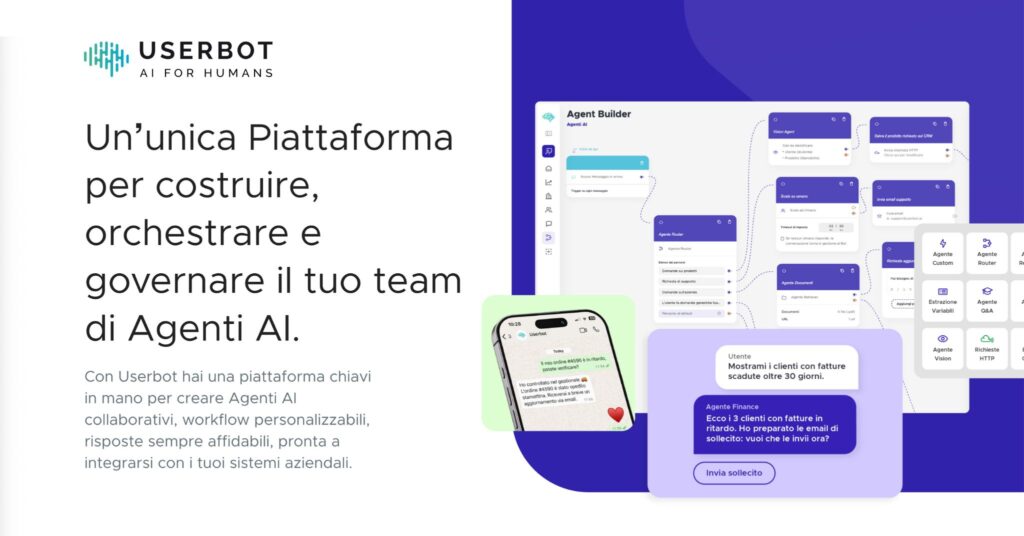
Build and deploy AI agent teams through a visual no-code platform, connect them to business systems, and manage conversations across WhatsApp, web, email, and voice channels.
About
Userbot is an AI agent platform for building teams of bots that handle customer conversations. You use it when you need 24/7 coverage without hiring more people.
You build agents in a visual, no-code canvas. You connect them to your support channels, your knowledge base, and your CRM. You hand off to humans when the bot gets stuck.
It sits in AI agent work. It is best for teams drowning in the same questions over and over.
Open it if you need fast ticket deflection with human backup. Skip it if you need deep, custom conversation flows.
Who Userbot is best for
These are the jobs where it earns its keep.
- E-commerce companies handling repetitive customer queries: You stop answering "where is my order" fifty times a day. You get those hours back.
- Customer support teams needing 24/7 coverage: You cover nights and weekends without overtime. You hand complex issues to your team when they are back.
- Online sales operations where response time impacts conversion: You answer in seconds instead of hours. You catch buyers while they are still on your site.
- Teams prioritizing quick implementation over deep customization: You go live in days, not months. You skip the engineering queue.
- Teams needing no-code AI agent orchestration: You build multi-agent flows with drag-and-drop. You do not write code to route tasks between bots.
- Companies wanting ticket deflection with human backup: You let the bot handle the easy 70%. You keep your team for the hard 30%.
- Teams wanting photorealistic avatar-based customer interactions: You use Digital Humans for a more human feel. You stand out from plain text chat.
- Businesses with simple, predictable customer inquiries: You map your FAQs and deploy fast. You do not try to automate edge cases.
- Organizations prioritizing omnichannel customer experience: You run the same bot on web chat, WhatsApp, email, and voice. You keep context as customers switch channels.
- Teams drowning in ticket volume and facing agent burnout: You stop your team from quitting. You let bots take the repetitive load.
Best things about Userbot
These are the parts you notice after you start using it.
- Visual Agent Builder with specific agent types: You pick from Custom, Router, Retriever, and Vision agents. You know which tool to grab for each job.
- Three-tier memory system: You choose Stateless, Conversational, or Deep Memory per agent. You match memory depth to the task instead of overpaying for every call.
- Multi-model flexibility: You switch between OpenAI, Anthropic, Azure, or your own models. You avoid being stuck when one provider changes pricing.
- Rapid data ingestion: You feed it documents and endpoints in minutes. You skip weeks of manual training.
- Digital Humans avatars: You add photorealistic faces to your chat. You get higher engagement than text-only bots.
- Credit-based pricing: You pay for what you use. You predict costs instead of guessing at flat-rate tiers.
How you use Userbot
The setup follows five clear steps.
- Add your knowledge base from documents or API endpoints.
- Define each agent's personality, tasks, and memory level.
- Build teams of agents that hand off work to each other.
- Connect to your channels and business systems via API or webhook.
- Watch performance dashboards and adjust handoff rules.
Why you should ignore it
Skip it when the fit is wrong.
- Limited conversation depth: You are stuck with simple Q&A formats. You cannot build branching, complex flows without hitting walls.
- Weak learning over time: You see inaccurate responses that do not improve. You babysit the bot instead of trusting it.
- Opaque custom pricing: You cannot see costs upfront. You negotiate instead of self-serving.
- Thin real-world validation: You find few user reviews or case studies. You buy on promises, not proof.
- Generic positioning: You struggle to tell it apart from Intercom or Zendesk. You wonder what you are paying extra for.