
SEO Bot
Paid
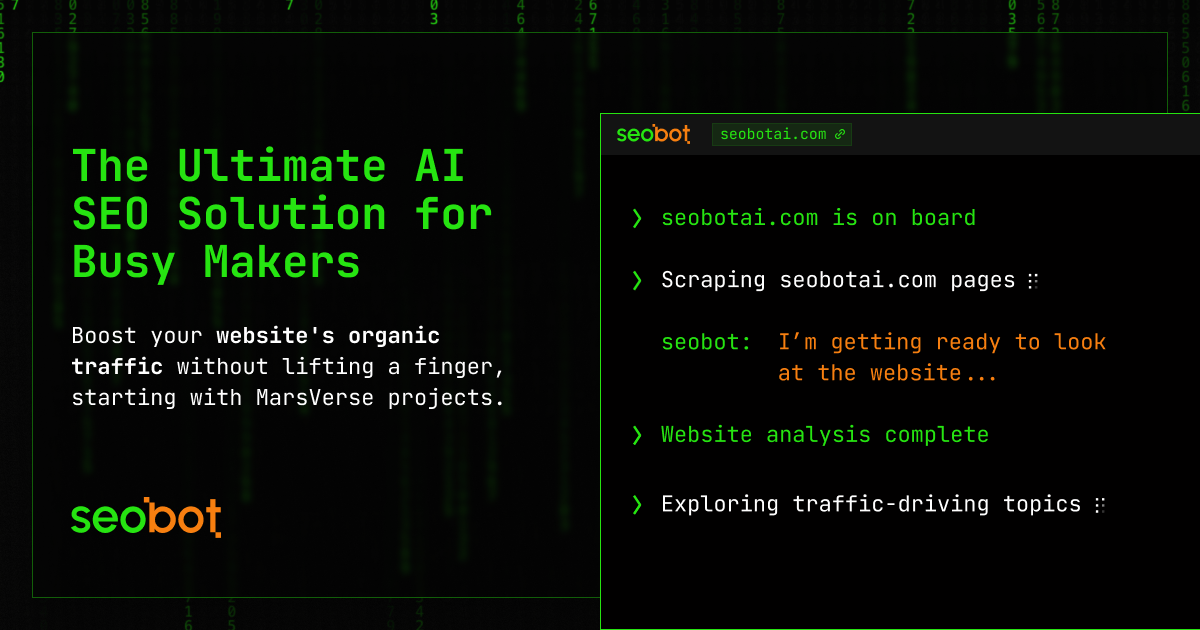
Automate SEO with AI agents that research keywords, write optimized articles with internal linking and images, and publish weekly to your CMS.
About
SEO Bot is an autonomous agent that handles SEO work. You connect it to your site and it researches, plans, writes, and publishes content on a weekly schedule.
The tool works with WordPress, Webflow, Shopify, Ghost, Wix, Framer, Notion, HubSpot, and Next.js. It also offers a REST API and webhooks for other setups.
It sits in SEO work. It is a poor fit if you want full control over every draft.
Open it if you want hands-off content that runs itself. Skip it if you need tight editorial control or custom complex campaigns.
Who SEO Bot is best for
It helps most when you want SEO results without doing the work yourself.
- Busy founders without SEO expertise: You get a full pipeline without learning SEO. The agent handles research to publishing.
- Content strategists needing multilanguage scale: You publish in 50+ languages from one source. The tool translates and adapts content automatically.
- SEO agencies handling programmatic content for niches: You build data-driven templates and generate articles at scale. The templates keep format consistent.
- Small business owners wanting hands-off organic traffic: You queue content and let it run. The weekly schedule publishes without your input.
- Publishers on Shopify, Wix, Framer, or Next.js platforms: You skip custom integrations. Native connections publish directly to your store or site.
- WordPress users wanting internal linking automation: You get suggestions inside your editor. The plugin works alongside Yoast or Rank Math.
- Developers who need programmatic access: You fetch articles via API with built-in caching. The npm package includes types and SSR examples.
- Teams experimenting with AI coding agents: You use the included integration guide for Cursor, Copilot, Claude, or Lovable. The prompts get you running fast.
Best things about SEO Bot
These are the parts you notice after a few weeks of use.
- Automatic internal linking: It finds places to link within your own content. You stop manually hunting for relevant posts.
- YouTube-to-article conversion: You paste a video link and get a written article. It saves republishing video content as text.
- Fact-checking with citations: The tool adds source links to claims. You spend less time verifying what the AI wrote.
- Backups before AI changes: WordPress users can restore if something breaks. You feel safer letting the agent edit live posts.
- Multi-provider AI routing: You switch between OpenAI and Anthropic models. You pick the one that writes better for your niche.
Why you should ignore it
Skip it when these limits block your work.
- No verified traffic results: The tool runs but you cannot see clear proof it ranks. You may wait months without knowing if it is working.
- Pricing requires contact: You cannot self-serve most plans. Expect calls and negotiation instead of instant signup.
- Advanced tweaks need manual work: The automation covers standard cases. Complex custom campaigns still need your hand.
- AI content can read robotic: Some output is keyword-heavy and flat. You may need to rewrite for voice and flow.
- Young plugin with few users: The WordPress version has under 10 active installs. Early bugs are still being patched.